Top Signs You Need Garage Door Service – Don’t Ignore These
A garage door that takes three seconds longer to open than it did six months ago isn’t “getting old.” It’s telling you a specific component is near the end of its service cycle, and that part will likely fail completely on a timeline measured in weeks, not years. The signs below are mechanical stress signals: the door is compensating for a failed part by overloading another one, which is why the symptom shows up long after the damage started. If you’d rather not climb the ladder yourself, call (855) 658-4170 and we’ll take a look.
Key Takeaways
- Most garage door failures announce themselves weeks in advance through speed, sound, or balance changes.
- A 60-second manual balance test can reveal a weakening spring before it breaks.
- Ignoring a small worn part usually turns a modest repair into a bigger one, so catching signs early genuinely cuts cost.
- Springs, cables, and opener wiring are not DIY territory. We’ll explain what to check and when to stop checking.
What are the five mechanical warning signs homeowners dismiss as normal aging?
These are the five signals our technicians treat as imminent-failure indicators, even though most homeowners read them as “the door is just old.” Each one points to a specific part under stress.
- The door reverses or stops halfway. This usually traces to a failing opener logic board or a misaligned safety sensor, not the door itself. An opener that quits mid-travel is telling you the motor is straining or a limit switch has drifted.
- The door feels heavy when you lift it by hand. A properly balanced door lifts with light resistance. If it feels like lifting a loaded wheelbarrow, the springs have lost tension and the opener is now doing work it was never built to do.
- The door drifts down a few inches when left half-open. This is the balance test failing, and it’s one of the clearest spring warnings you’ll get.
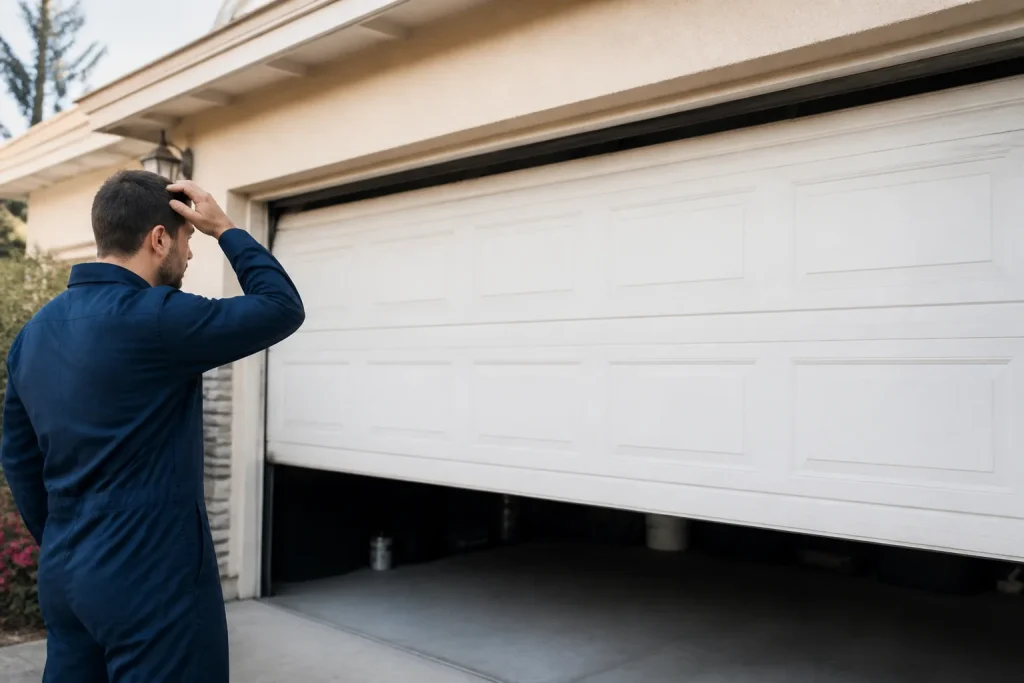
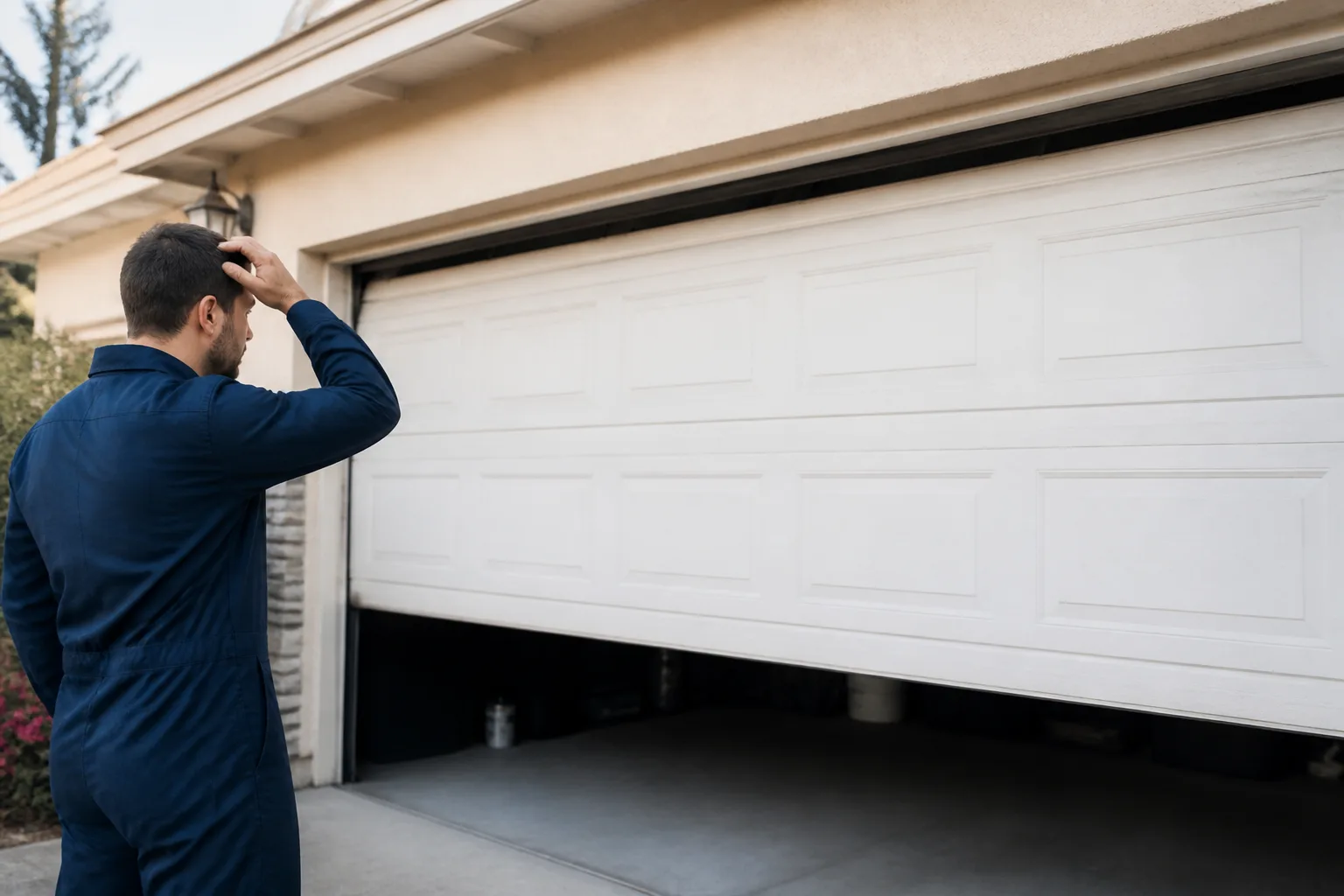
- One side of the door sags or the gap at the bottom is uneven. That’s a cable, roller, or track alignment problem, and it tends to worsen fast once a panel starts to bind.
- The opener runs but the door doesn’t move. A stripped gear, snapped drive belt, or disengaged trolley. On a chain or belt drive this is common as the unit ages, and it’s a routine fix.
None of these are cosmetic. Each one means the system is working around a failed part, and every cycle accelerates the wear on whatever is still holding.
How do you run a 60-second balance test to catch a failing spring early?
The balance test is the single most useful check a homeowner can do, and it takes about a minute. It reveals spring tension problems before they turn into a spring failure, and that’s the difference between a scheduled repair and an emergency on a Sunday.
Here’s how it works. Close the door fully, then pull the manual release cord to disconnect the opener. Lift the door by hand about halfway and let go. A healthy door stays put, or drifts only slightly. A door that drops quickly, or one that won’t stay up at all, has weak or broken springs.
What you’re feeling for is effort. A balanced door on good springs feels light. If you’re straining to lift it, stop and call us. Do not try to adjust, oil, or remove the springs yourself. Torsion and extension springs are under extreme tension, and a spring that lets go can cause serious injury. That’s a repair for a trained technician, full stop. If your test comes back bad, our garage door repair service starts with a proper spring assessment.
Run this test a couple of times a year, especially if you’ve noticed the door acting sluggish in Corona’s cold snaps and summer heat. Steel springs and the door’s own metal expand and contract with temperature swings, and a marginal spring often shows its weakness first on the coldest morning of the year.
Why does door speed change, and what does it tell you?
Inconsistent speed is one of the most telling signs in Corona, and homeowners rarely connect it to a hardware fault. If the door races down but crawls up, that pattern is specific: it usually means the springs are losing tension (so the opener fights gravity on the way up) or a roller or hinge is binding and dragging on the way down.
- Faster on the way down, sluggish up: weakening springs or a worn roller taking load off the spring system.
- Jerky, uneven travel in both directions: a binding track, a bent section, or a roller that’s jumped its rail.
- Slowing near the top or bottom only: an opener force setting or limit switch that needs adjustment before it strands the door.
Speed changes are your earliest warning. By the time the door actually stops, the underlying part has often been failing for weeks. If you notice the change on a garage door opener repair call, we check the full drive train, not just the motor, because the opener is usually the messenger, not the cause.
The noise taxonomy: which sounds mean call now?
Not every noise is an emergency, but some are. Here’s how our technicians sort them:
- Popping or a loud bang from above the door: a torsion spring snapping. Stop using the door immediately. This is a “call today” sound.
- Grinding: metal-on-metal contact, often a worn roller or a track out of alignment. It will chew up the track if left alone, so schedule it soon.
- Squeaking or squealing: usually dry hinges, rollers, or a dry opener rail. Often a lubrication and tune-up fix, not urgent, but worth doing before it becomes grinding.
- Rattling: loose hardware or a bolt that’s backed out. Catch it before a hinge works loose and binds a panel.
Here’s the pattern a lot of Corona homeowners notice: a squeak they’ve tuned out for months suddenly becomes a grind, and the repair bill jumps with it. A popping sound is the one sound you shouldn’t wait on, because a broken spring means the door is being held by the opener and cables alone, and that’s a genuine safety concern. For any opener brand in your garage, from LiftMaster to Chamberlain to Genie to Craftsman, the drive-train check catches these noise sources before they compound.
Why does a small problem get expensive if you wait?
This is the compounding cost argument, and it’s why we push homeowners to act on early signs. A worn roller that’s ignored doesn’t just get worse. It drags on the track and damages the track itself. What should have been a low-cost roller replacement becomes a track repair plus the rollers, and the number roughly triples.
The math looks similar across the system. A marginal spring stretches the opener’s gears. A loose hinge bends a panel. A misaligned track wears the rollers. In our experience, the parts that fail first are the cheapest ones to replace, and the parts they drag down with them are the expensive ones. Catching the signal early is the single best way to keep a repair modest. The written estimate always sets the final price, and we quote it before any work starts, so there are no surprises when the truck leaves.
If you’re planning ahead rather than patching, it’s worth knowing the difference between fixing what you have and garage door installation. A door in the right condition gets repaired; a door that’s failing on multiple fronts may be worth replacing.
When should you call a pro instead of checking further?
Call a trained technician the moment you suspect springs, cables, or opener wiring. Those three are where the real danger lives, and a DIY attempt on any of them can end badly. For everything else, a routine inspection by a professional saves you money the same way catching a leak early saves a homeowner on a roof.
We work on all major brands, including Clopay, Amarr, Wayne Dalton, and Craftsman, so we’re not pushing you toward a replacement or a preferred manufacturer. We fix the system already in your garage. Our technicians have up to 10 years of experience diagnosing exactly these signs, and if it can’t wait, emergency garage door service is a core part of what we do. In Corona, that often means a door that won’t close securely enough to leave the house safe, and we treat it like the access and security problem it is.
Related services in Corona: if you’ve spotted a failing spring or opener, our team covers both, and you can start with the main Corona Garage Door Repair Pros page to see the full scope.
The Bottom Line
Most garage door failures don’t happen without warning. They happen after weeks of ignored signals: a door that got slower, a popping sound, a balance test that failed. The five mechanical signs above, the 60-second balance test, the speed pattern, and the noise taxonomy all point to the same idea: the door is telling you what’s about to break, and the sooner you listen, the cheaper the fix. If you’re in Corona and need help, Corona Garage Door Repair Pros offers free estimates. Call (855) 658-4170 and we’ll get your door back on track.
Frequently Asked Questions
A change in how the door moves: slower, heavier, jerky, or reversing on its own. Speed and balance changes usually appear weeks before a part fails completely, so they’re the earliest reliable warning. If the door no longer passes the 60-second balance test, it’s time to call. Call (855) 658-4170 for a free estimate.
No. Torsion and extension springs are under extreme tension, and releasing one incorrectly can cause serious injury. This is one of the most dangerous DIY repairs in the home, and it’s a job for a trained technician. Our dedicated spring repair service handles it safely. Call (855) 658-4170 if you suspect a spring problem.
Usually not. Squeaking is often dry hinges, rollers, or an opener rail and tends to be a lubrication and tune-up fix. A popping or loud bang, though, signals a snapping spring and is urgent, so stop using the door and call right away. Call (855) 658-4170 for an exact quote, and estimates are free.
If the opener runs but the door doesn’t move, that’s typically the opener or its drive train. If the door moves but strains, the problem is usually springs or balance. A technician can tell the difference in minutes. Call (855) 658-4170 and we’ll diagnose it for you.
Written by the team at Corona Garage Door Repair Pros.
Need Garage Door Help?
Call Corona Garage Door Repair Pros - the local pro we connect you with is licensed and insured, here with fast after-hours help in Corona.
(855) 658-4170